
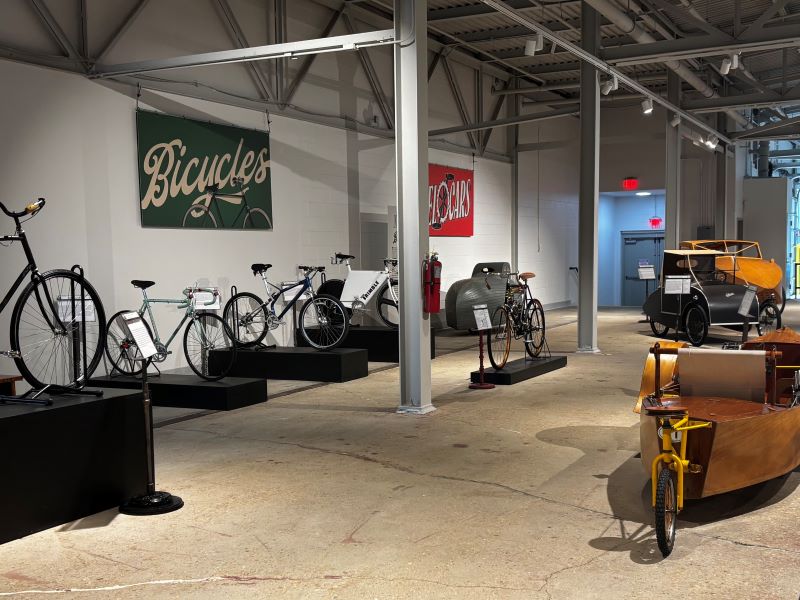
Bicycles & Velocars On Display Now
The bicycle played a vital role in the development of the automobile. From the bicycle, engineers were able to understand the transfer of power. In the case of the bicycle, it was the transfer of power from the human legs pedaling a crankset connected to either a chain, a set of gears, or a shaft which then drove the rear wheel of the bicycle. This knowledge of power transfer in the bicycle would directly be implemented into the earliest automobiles, including Henry Ford’s Quadricycle, which used a bicycle chain as its mode of transferring power from the engine to the rear wheels of the vehicle.
During the 1920s and 1930s, a unique form of a bicycle/automobile hybrid was introduced, known as the Velocar, these small, affordable vehicles were pedal powered cars. As they developed, some would see the adaptation of a small internal combustion engine added to them, commonly from a scooter. The most well-known company for producing Velocars was Mochet, founded by Charles Mochet of France. The history of the bicycle and the Velocar did not end with the advent of the automobile, though. The bicycle remains a ubiquitous mode of transportation around the world and has seen great advancements since its inception. Although the Velocar is not as prominent in our lives today, they do still exist and can still be found in use today, many with electric motors to assist with powering the vehicle.