
Dacia 500 Lăstun – 1989
Sorry, no description available at this time.
Dacia 500 Lăstun – 1989 Read More »

Sorry, no description available at this time.
Dacia 500 Lăstun – 1989 Read More »

Little is known about French inventor Hippolyte Delimal. But in 1936 he attempted to create the world’s smallest car, which reached a speed of 24 mph and touted fuel economy of 118 mpg. He affectionately named it Le Carabe, or the “Ground Beetle”. His vision and enthusiasm could be seen in a completely intact, hand-written,
Le Carabe II (replica) – 1936 Read More »

Sorry, no description available at this time.
Daus Pritschenwagen Prototype – 1954 Read More »
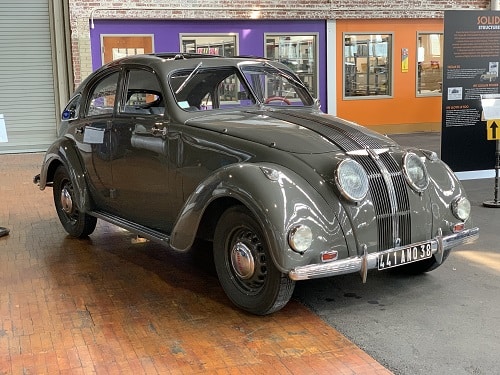
Frankfurt-based, Adler started manufacturing bicycles in 1896. Later the company turned to produce motorcycles, typewriters—and moved on to cars. In early 1900, Adler was already manufacturing automobile components when its first car, a Renault-influenced, De Dion Bouton-powered, lightweight “voiturette” was introduced. But within only a few years, the company proceeded to its own single- and
Adler Type 10 2.5 Litre – 1938 Read More »

Sorry, no description available at this time. Specifications:Manufacturer: Gutbrod Motorenbau GmbhCountry of Origin: West GermanyDrivetrain Configuration: UnknownEngine: Gutbrod; water-cooled, two-stroke, direct-injected inline 4-cylinder; 30hp, 663ccTransmission: 3-speed manual transmissionTop Speed: 72 mphYears of Production: 1950-1954Number Produced: 6,860 (cabriolet saloons), 866 (estates)Original Cost: 4,380 Deutsch Marks, $1,040 USD
Gutbrod Superior – 1953 Read More »

In 1945, industrialist Henry J. Kaiser, along with veteran automobile executive Joseph Frazer, started the automobile company Kaiser-Frazer. A year later he also formed Kaiser Aluminum and commissioned Rhys Miller and Frank Hershey (designer of the original 1956 Ford Thunderbird two-seater) to produce a portfolio of all-aluminum car designs to feature in promotional literature. Their
Futura/Waimea – 1961 Read More »

At the beginning of the 20th century, very few people had any knowledge of how or even why automobiles worked. The German Chauffer School, founded in 1904, was created to deal with this problem. Part of the driver’s training was to gain not only an understanding of how to drive, professional etiquette, and road rules,
Hohm Full-Frame Modelle Car Read More »

This horse-drawn, pumper-style fire engine features an air-cooled Tatra engine and was used by the local fire brigade in Busswil, Switzerland, as late as 1938.
Tatra-powered Fire Pumper Read More »

Stickney Hit-and-Miss engines were made from 1903-1914 in St. Paul, Minnesota. Total production was 23,853 in those 11 years. Engine size ranged from 1 3/4hp- 20hp.
Stickney Hit and Miss Engine – 1910 Read More »