
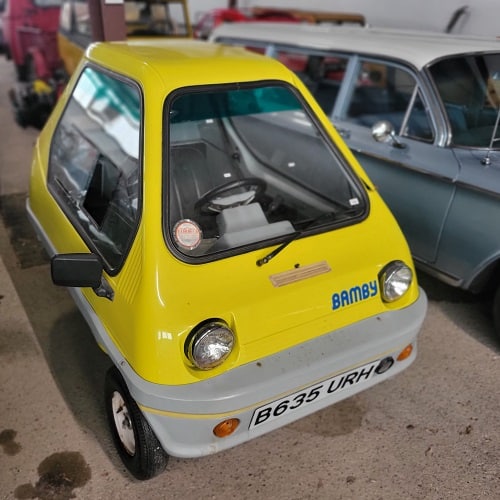
Bamby – 1984
The Bamby Car was a modernized fiberglass microcar based off Peel Engineering Company’s P50 microcar. Devised by Alan Evans of Hull, England, the Bamby Car was meant to serve as an inexpensive and safe vehicle for housewives and young drivers. Then named after the iconic Disney cartoon character, Bambi, the company envisioned that the misspelt name would both attract customers to the small and cute car, but also to avoid copyright issues.
The 1983 Mk. 1 lacked sufficient power and had poor night-time visibility with a single ‘cyclops’ headlamp. The Mk. 1’s gullwing door also caused the vehicle to be too expensive in manufacturing costs for its intended audience’s price point. The Mk. 2 at first had a Yamaha moped engine, then was upgraded to a more powerful Suzuki moped engine, replaced the gullwing door with a traditional front hinge door, and was given traditional dual front headlights. When premiered at the Ideal Home Exhibition in 1984, it was given praise and public approval, though sales did not meet expectations. This led to the final Bamby Car Mk.2 being produced less than a year later, with only around 50 of both models being produced in total. The company would later revitalize under Alan Evans in the 2000s with the Bamby P50 replica.
Specifications
Manufacturer: Bamby Cars Ltd.
Country of Origin: Hull, England, United Kingdom
Drivetrain Configuration: Rear-engine, rear-wheel drive
Engine: Suzuki Petrol engine; 49cc
Transmission: 3-speed Automatic, no reverse
Top Speed: 37 mph
Years of Production: 1983-1984
Number Produced: 50 total Bamby Cars, 25 Mk.2 models
Original Cost: £1,597 (~$4772.85 USD)